
Technical Note
From Chat Completion to Structured Context Evaluation
As agents work across sessions, tasks, and concurrent objectives, a linear message history is no longer enough to carry their cognition. Morphz proposes a different computational model in which structured context itself becomes the object of evaluation.
Large language model agents can now work for hours, continue across sessions, and pursue several objectives concurrently. Yet in most agent systems, every model request must still reconstruct the agent's current state as a chat transcript.
This article defines Structured Context Evaluation and explains how it supports durable cognition, concurrent work, and deterministic state commits.
Chat completion made large language models usable as a general interface. It is simple, natural, and remarkably open-ended. A person says something; a model produces what comes next. A tool call is merely a special kind of response within that exchange. There is nothing wrong with this computational model, but today's agent systems require it to carry responsibilities far beyond conversation.
Agents now have tools, memory, workflows, subagents, schedules, permissions, and durable state. Their runtimes are no longer chat windows. Yet what the model usually sees remains a linear sequence of messages that must be extended, compressed, and rewritten over time.
The agent has moved beyond chat. Its computational model has not.
A transcript is not cognitive state
In a linear agent, one evaluation can be approximated as:
next_message = model(instructions, message_history, tool_results)
Instructions define the rules. Message history carries the past. Tool results bring reality back to the model. A runtime may surround this sequence with summarization, retrieval, and state machines, but the model's fundamental object remains a record of what was previously said.
That works extremely well for short tasks. As work grows longer, the same history must represent facts, objectives, progress, causality, preferences, tool state, and the agent's understanding of itself. Information with different owners and lifecycles is pushed into one container and distinguished mostly by natural-language position and model attention.
Compression becomes a risk of forgetting. Concurrency becomes interleaved messages. Recovery becomes another retelling of the past. Memory often means finding old text and placing it back into new text.
Morphz aims to change not the way a prompt is written, but the object presented for computation.
Context is not a prompt
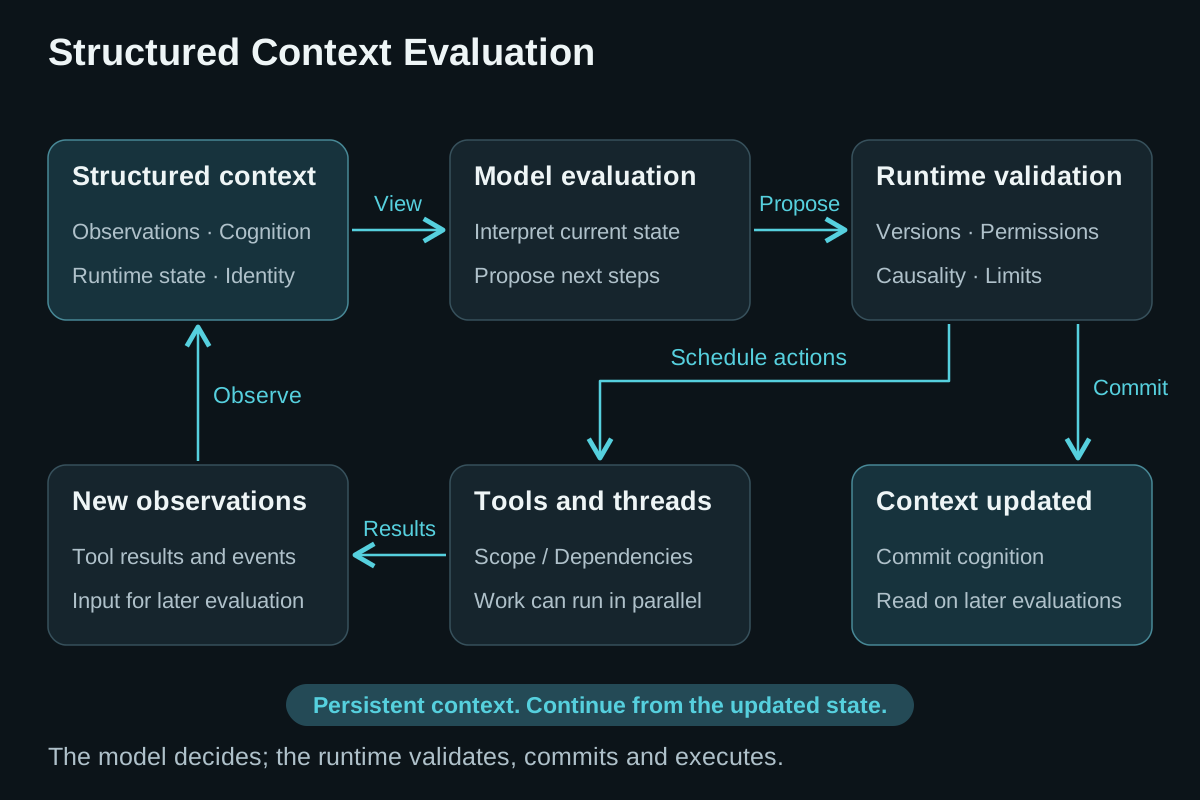
In Morphz, a Context is not the string about to be sent to a model. It is an identity-bearing, versioned cognitive state owned by an agent. A prompt is only the view compiled by the Runtime for one bounded Evaluation.
A conceptual Morphz Context looks like this:
(context
  (protocol ...)
  (evaluation-profile none)
  (inbox ...)
  (observation-state ...)
  (mind ...)
  (session-directory ...)
  (kernel ...)
  (evaluation-environment ...)
  (evaluate ...))
Observations, cognition, Sessions, Runtime facts, and the current Evaluation entry point form one Context in a fixed order, with distinct ownership rules. mind belongs to the Agent, kernel to the Runtime, and evaluate selects the current Evaluation.
The model can interpret Runtime facts but cannot forge them. It decides what has cognitive meaning, but it modifies cognitive state through versioned transactions. The Runtime does not make that semantic judgment; it preserves provenance, ordering, authority, and commit boundaries.
Context therefore stops being an input assembled for one request. It becomes a first-class object that persists, projects, changes, and recovers.
Structure is not a serialization format
Merely wrapping messages in JSON, or placing XML tags around text, does not automatically create structured cognition.
Structured data becomes structured Context only when its parts have stable identity, ownership, lifecycle, relations, and transition semantics. The model cannot merely read it as background information. It must understand which part it is evaluating and which state transitions it is allowed to propose.
The important shift is not:
text message -> structured message
It is:
generate the next message -> evaluate the current context
Under this model, an agent step is closer to:
context[t+1] = evaluate(context[t], event, capabilities)
evaluate is not a deterministic function in the conventional sense. The language model acts as a nondeterministic semantic evaluator: it interprets new observations, decides what deserves a place in durable cognition, chooses an action, and proposes a structured transition. The same input may produce more than one reasonable result.
Determinism belongs on the other side of the boundary. The Runtime validates structure, versions, causal scope, authority, and resource limits, then commits or rejects the proposed transition. Nondeterministic cognition and deterministic facts can coexist without pretending to be the same thing.
Persistence and concurrency stop being peripheral features
Once cognitive state is independent of message history, several capabilities that look unrelated begin to follow from the same abstraction.
A Session is a first-class interaction and execution object inside Context, not an external memory container. For each Evaluation, the Runtime compiles a bounded Session Working Set. The current Session receives a full projection; other Sessions may be fully projected, represented as metadata only, or swapped out of the current Context Encoding. Swapping out does not delete the Session or Event History.
A Thread is a causal path of work, not the conversation as a whole. While an older task waits for a tool, a new dialogue can continue. The result returns only to the path that requested it instead of leaking into another Evaluation.
An Objective is a durable control structure spanning Evaluations, waits, and execution Threads. It does not need to survive as one more reminder hidden somewhere in the transcript.
Concurrency no longer means only running several copies of a conversation. Different Evaluations can work against the same Context and modify independent Frames through versioned transactions. The Runtime can safely rebase independent changes and reject genuine conflicts.
Context capacity does not depend on summaries generated automatically by the Runtime. The Runtime measures physical Token pressure. The Agent explicitly maintains cognition through derive, revise, retire, restore, and protect; the Session Working Set separately controls which Sessions receive full projections in the current Encoding. Semantic maintenance, physical projection, and historical preservation therefore keep distinct boundaries.
All of this still requires substantial engineering. The difference is that these capabilities no longer depend on unrelated patches. They share one state model.
Why S-expressions
Parentheses are not magic. Morphz does not use S-expressions because JSON cannot represent a tree, or because the system needs to look like a programming language.
Their value is that data, protocol, and executable programs can share one minimal representation. Nesting is explicit. Composition does not require a new message envelope at every layer. The same tree can represent cognitive state, the current Evaluation entry point, and a candidate evaluation program. Morphz calls this program language Yao.
More importantly, S-expressions make the computational object explicit: an Agent's current cognitive state and an expression to evaluate, rather than a formatted document.
Structured Context Evaluation does not depend on one parenthesized syntax. It depends on stable semantics. Another encoding that preserves the same identity, ownership, transaction, and evaluation contracts could implement the same paradigm. Morphz chooses S-expressions because they give those semantics a language foundation that can continue to grow.
Training for Structured Context
Agent post-training today is still largely organized around answers, reasoning traces, and tool calls. Even as runtimes improve, training helps them indirectly: the model becomes better at conversation and tool use, and an external system assembles those abilities into an agent.
When structured Context becomes the native object of evaluation, post-training can directly target the following capabilities:
- how to revise cognition in response to evidence instead of merely appending text;
- how to distinguish transient Observations, durable knowledge, and Runtime facts;
- how to maintain shared cognition across concurrent work;
- how to propose verifiable, reversible, provenance-bearing state transitions;
- how to organize its own Context under a finite budget.
This training direction is independent of the current Morphz Runtime. Existing models can use Morphz through structured inputs and output contracts; training specifically for Structured Context can further improve evaluation quality and efficiency.
Operating boundaries and engineering cost
Structured Context has explicit costs. A changing cognitive state can reduce prefix-cache reuse. Today's models are trained primarily for natural-language conversation. Protocols, transactions, and scheduling require independent implementation and verification.
Structured Context should be evaluated under the same model, task, and comparable budget across information retention in long-running work, interference between concurrent workstreams, cognition transfer across Sessions, and the resource cost of maintaining those properties. Morphz has conducted layered evaluations under this principle; the research paper reports their protocols, results, and limitations.
Morphz publishes its current implementation through source code, product documentation, tests, and experiment materials.
Conclusion
This article does not argue for eliminating chat. Conversation remains one of the most natural interfaces between people and agents. What must change is the assumption that a transcript should continue to serve as the ontology of an agent's entire cognition.
If agents are to become durable actors, they need cognitive state they can continuously own. If they are to face many people and objectives at once, they need causality and concurrency semantics stronger than message order. If they are to learn, they need to revise, relate, and protect cognition, and move Frames out of the current window and restore them when needed instead of accumulating everything ever said.
In this computational model, chat is input and output. Cognition is not a by-product of conversation; it is a structure that can be held, evaluated, committed, and continued. Morphz is an open-source implementation of this model.
Read the core concepts, or inspect the implementation on GitHub.